The Summers End Group Marina – Federal Permit Review
Last week I wrote about the path taken by the Summers End Group in obtaining a Virgin Islands Coastal Zone Management permit for the construction of a mega marina in Coral Bay. That unorthodox and most likely illegal path was characterized by conflicts of interest, political pressure, administrative appeals, and ultimately a vote of a lame duck Legislature to approve a highly flawed CZM permit and Trust Land lease. It didn’t need to be that way.
The Coastal Zone Management Act is the first line of defense protecting our coastal resources from environmentally damaging development. The CZM Act is designed to balance utilization with protection so that projects which are ultimately approved within Tier One of the coastal zone are ones which enhance the economy while limiting damage to the environment. For a large commercial project like the Summers End Group mega yacht marina, this is a complex balancing act that should involve detailed study, planning, and expert evaluation. And it also involves time.
Unfortunately none of that took place with the Summers End Group CZM permit application. That application went from submission in March 2014 to a completeness determination by DPNR in June 2014, a record time of only three months. Permits for private homes routinely take many times longer than that to be deemed complete. For a marina of this scale to be signed off by DPNR in three months is nothing short of negligent.
In October 2014, just three short months later, two members of the St John CZM Committee had voted to approve the permit, with a third member – Brion Morrisette – not voting due to a conflict of interest. This approval was in spite of extensive public opposition, without any meaningful habitat studies, and with a cursory examination of critical resource impacts. What followed was six years of appeals and lawsuits, without any further environmental review, ultimately leading to the Legislature’s vote of approval in December 2020.
In contrast to the Virgin Islands CZM review of the Summers End Group project, the federal review by the United States Army Corps of Engineers and other involved federal agencies has been conducted in a thoroughly professional, scientific, unbiased and comprehensive manner. In this note I will review the steps which have been taken by the Army Corps, by the Applicant (Chaliese Summers), by the public, and by the federal agencies during the seven years this permit application has been under review. The review is organized as a time line, and each step of the process can be researched in greater depth by following the links to the underlying documents for that step.
If you are interested in just one event on the timeline you can click on the item below to jump to that section. Alternatively you can simply read through the entire story, which is still unfolding …
- Background: Army Corps Permits
- 2014: The Year it All Started
- April 1, 2014: Summers End Files First Army Corps Permit Application
- September 16, 2014: Permit Application Deemed Incomplete by Army Corps
- September 22, 2014: Second Army Corps Permit Application Submitted
- 2015: The Public and Federal Agencies Weigh In
- January 7, 2015: First Army Corps Public Notice
- January 2015: Unprecedented Public Opposition Submitted to Army Corps
- February 3, 2015: Coral Bay Community Council Responds With Extensive Documentation and Expert Reports
- February/March 2015: Five Federal Agencies Submit Comments to Army Corps Objecting to the Summers End Group Marina
- March 3, 2015: US EPA Designates Coral Bay an Aquatic Resource of National Importance and Advises Army Corps to DENY the Summers End Group Permit
- March 17, 2015: Boating Infrastructure Grant Award Rescinded
- April 9, 2015: Summers End Group Required to Resubmit New Permit Application
- May 2015: Summers End Group Submits THIRD Army Corps Permit Application
- June 2015: Third Permit Application Deemed Incomplete
- July 2015: Army Corps Publishes Second Public Notice for Comments
- August 2015: Comments Received During Second Public Comment Period
- October 3, 2015: Army Corps Visits Coral Bay After Public Comment Period
- October 22, 2015: Army Corps Transmits Extensive Request for Additional Information to Summers End Group
- November 3, 2015: Summers End Permit Review Put Into Abeyance
- 2016: No Response from SEG …
- 2017: The Year of the Hurricanes … And Summers End Responds to Army Corps
- February 1, 2017: Public Letter to Army Corps Requesting Permit Denial
- August 2017: Summers End Submits Responses to Army Corps
- September 2017: Two Category 5+ Hurricanes Devastate Coral Bay
- October 2017: Army Corps Issues Second Request for Additional Information
- December 2017: Summers End Responds With Additional Studies
- 2018: Army Corps Initiates Consultation With Federal Agencies
- January 2018: Army Coprs Issues Third Request for Additional Information and Preliminary Public Interest Determination’
- March 2018: Summers End Submits Additional Materials to Corps
- May 2018: Save Coral Bay and CBCC Analyse and Respond to Additional Summers End Submissions
- April 2018: Coral Bay Property Owner Files Lawsuit Against Chaliese Summers
- July 2018: Army Corps Initiates Formal Consultation With Federal Agencies
- September 2018: Federal Agencies Request Additional Studies and Information
- 2019: Agencies Request Additional Information to Initiate their Reviews
- March 2019: Summers End Has Not Responded to Agency Requests
- December 2019: Summers End Submits Responses to Agency Information Requests
- 2020: Federal Agencies and Army Corps Still Waiting for Adequate Responses
- March 4, 2020: Save Coral Bay Find Multiple Deficiencies in SEG Agency Responses
- March 26, 2020: Army Corps Requests Additional Information from Summers End
- 2021: Major Developments – Historic Shipwreck and Extensive Deficiency List
- March 30, 2021: Local Coral Bay Family Files Lawsuit Against Summers End Group and Brion Morrisette
- ???: Shipwreck
- September 13, 2021: Army Corps Transmits Extensive List of Application Defects to Chaliese Summers
Background – When is an Army Corps Permit Required?
The requirement to obtain federal authorization for a marina project such as the Summers End Group marina in Coral Harbor is triggered by two federal statutes.
First, in 1899 the US Congress enacted a law stating that construction in the navigable waters of the United States is illegal unless it has been authorized by the Department of the Army. This provision is known as “Section 10 of the 1899 Rivers and Harbors Act” and a marina clearly requires permitting under Section 10.
Second, the 1972 Clean Water Act gives the US Environmental Protection Agency (“EPA”) broad powers to regulate the discharge of pollutants into the waters of the US. Specifically, Section 404 of the Clean Water Act regulates the discharge of dredge or fill materials and prescribes criteria that must be met in order for this activity to be permitted. Since construction projects in navigable waters require Department of the Army permitting under Section 10, in most cases the Army Corps administers both the Section 10 permit process as well as the Section 404 Clean Water Act permit process under delegated authority from the EPA. However, although the EPA has delegated Section 404 permitting authority to the Army Corps, for certain activities in certain bodies of water the EPA retains ultimate approval power. This will later become important for the Summers End project.
The Army Corps of Engineers Review Process
The process by which the United States Army Corps of Engineers (“USACE”) determines whether or not to issue a permit involves a highly complex and consultative deliberation governed by multiple federal statutes and regulations. As stated previously, Department of the Army permits for private projects are typically issued pursuant to two federal authorities: Section 10 of the 1899 Rivers and Harbors Act, and Section 404 of the Clean Water Act. The review process for both of these authorities is very similar and is typically done as a single unified review.
Fundamentally, USACE cannot issue a permit unless the project is compliant with a long list of federal statutes. These statutes include:
- Federal Coastal Zone Management Act of 1972
- Section 401 of the Clean Water Act of 1972
- National Historic Preservation Act of 1966
- Endangered Species Act of 1973
- Fish & Wildlife Act of 1956
- Migratory Marine Game-Fish Act
- Magnuson–Stevens Fishery Conservation and Management Act of 1976
- Marine Mammal Protection Act of 1972
- Fish & Wildlife Coordination Act of 1934
- Clean Air Act of 1970
- Resource Conservation & Recovery Act of 1976
- Comprehensive Environmental Response Compensation and Liability (Superfund) Act of 1980
Since these statutes are administered by different federal agencies (e.g. EPA, FWS, NOAA) the role of the Corps, as lead agency in the review, is to coordinate with the other involved agencies to create a unified response to a permit application.
The process of permit acceptance, solicitation of public comments, review of comments, consultation with agencies, and final permit decision, is specified in the Code of Federal Regulation Section 325 for Department of the Army Permits. This section is written to comply with the National Environmental Policy Act (or NEPA) which provides the overall framework for environmental review of federal actions.
April 1, 2014: Summers End Files First Army Corps Permit Application
Ironically, it was on April Fools Day 2014 that Chaliese Summers signed and submitted her first permit application to the US Army Corps of Engineers. That permit application was accompanied by the same documentation submitted to the Virgin Islands CZM department – two Environmental Assessment Reports (one for the land components, one for the in-water components) and site plan drawings for the structures and for the marina.
The requirements for “completeness” of an Army Corps permit application are fairly meager. The post-application review process in the Corps is highly consultative – with other agencies, with the applicant, and with the public. However, at the time of application submission, all that the Corps requires is sufficient information so that a Public Notice can be issued and interested parties can submit comments. It does not require comprehensive environmental and resource information, which comes later in the process. So it is relatively straightforward for the Corps to find a permit application “complete” – meaning sufficiently complete that people can ask questions, provided the applicant has “dotted all the i’s and crossed all the t’s.”
2014 0401 USACE Application Executed
September 16, 2014: Permit Application Deemed Incomplete by Army Corps
In spite of the meager requirements for completeness, Summers End did not even meet those standards in their first Army Corps permit application. Whereas DPNR took only three months to determine the same application was complete for CZM processing, the Army Corps wrote to Chaliese Summers on September 16, 2014, five months after the Army Corps permit application was submitted, and notified her that it was deficient in several important regards. In particular the Corps noted that impacts on submerged aquatic vegetation (sea grass) had not been properly quantified, and there was no statement on compensatory mitigation. These issues would continue to be problems for the Summers End Group for years to follow.
2014 0916 SAJ-2004-12518 Incompleteness Letter (SIGN)
September 22, 2014: Second Army Corps Permit Application Submitted
One week following the first incompleteness letter, Summers End submitted a revised permit application, ostensibly addressing the missing items. In the cover letter accompanying the submission, Summers End consultant, Amy Dempsey, wrote to Army Corps reviewer Johann Sasso “I have gone into a lot of detail on the impacts/mitigation but I think that will be useful. And we have also include the maximum amount of riprap I can imagine we would need. Both the applicants and I were kind of shocked when you asked, for some reason all of us thought we weren’t doing anything to the shoreline just planting mangroves.” This casual response to the Corps, indicating that the Applicants were “shocked” by the Corps’ request and unaware of what “the engineers” included in the project, is once again indicative of the attitude of SEG towards the Corps.
2014 0922 COE Application executed
January 7, 2015: First Army Corps Public Notice
After reviewing the second permit application and deeming it complete, the Army Corps project manager at the time – Mr. Johann Sasso – prepared a draft Public Notice and circulated it for approval with the Applicant and other Army Corps staff. That first Public Notice was officially posted on January 7, 2015. It provided an overview of the project, based solely on the Applicant’s submissions (standard operating procedure). It provided some graphic components, such as the site overview and basic schematics. The public was invited to provide comments during a 30-day period.
2015 0107-SAJ-2004-12518-St.Thomas-0131-JMS(PN)
2015 0107-SAJ-2004-12518-St.Thomas-0131-JMS
January 2015: Unprecedented Public Opposition Submitted to Army Corps
The public response to the January 2015 Public Notice was incredible. Responses were so extensive that the Corps ultimately extended the comment period for an additional 30 days. The facts and figures of the public reaction tell the story of how strongly people were opposed to the concept of a mega yacht marina taking over the waters of Coral Bay. By the end of the comment period the Corps had received:
- Letters from over 13,000 individuals all opposed to the marina on a wide variety of grounds, including environmental, economic, social, navigational, historic, and aesthetic impacts.
- A petition signed by over 5,000 individuals all opposed to the Summers End Group marina.
- Well over a thousand individual requests for a public hearing on the permit application.
- A file of press clippings covering the past six months, including feature articles, op-eds and letters to the editor, all voicing public opposition to the project.
- Letters of opposition from a wide range of local, regional and national organizations, including:
- St John Historical Society
- Island Green Living Association
- Friends of the Virgin Island National Park
- Virgin Islands Conservation Society
- Coral Bay Community Council
- St John Yacht Club
- Coral Bay Yacht Club
- Virgin Islands League of Woman Voters
- National Parks Traveler
- National Parks Conservation Association
- Mission Blue
- Center for Biological Diversity
- Island Resources Foundation
February 3, 2015: Coral Bay Community Council Responds With Extensive Documentation and Expert Reports
Late in 2014 the Coral Bay Community Council (“CBCC”) was contacted by Attorney Robb Fox, from the nationally recognized environmental law firm of Manko, Gold, Katcher and Fox. Attorney Fox generously offered to assist the CBCC in putting together an appropriate response to the Army Corps of Engineers, on an tntirely pro bono basis. In addition to Manko, Gold, we were contacted by the law firm of Sive, Paget and Riesel who also offered their services, pro bono, on environmental issues. These two law firms are in the top tier of national environmental law practices.
With the invaluable assistance of Robb Fox, Jonathan Rinde, Mark Chertok and Maggie MacDonald, the CBCC put together a comprehensive response to the Public Notice for the Summers End Group marina. It was a monumental effort, culminating in the delivery of two volumes of comprehensive commentary delivered to the Army Corps in early February 2015. The CBCC response included:
-
- A 20 page cover letter outlining the key legal and policy reasons the permit should be denied.
- Expert reports from five highly acclaimed experts covering Economics, Fish Habitat, Endangered Species, Water Quality, and Navigation.
- Detailed comments submitted by local experts, including the CBCC itself.
- Full scale renderings of the proposed project, in correct context.
2015 0303 RFox Comments and Appendices-cover-letter
February/March 2015: Five Federal Agencies Submit Comments to Army Corps Objecting to the Summers End Group Marina
In addition to the extensive public comment, all of the involved federal agencies responded to the Army Corps with serious reservations, or outright objections to the Summers End Group project.
- The United States Environmental Protection Agengy stated that the waters of Coral Bay are an “Aquatic Resource of National Importance.” This designation means that any permit application in Coral Bay may be subject to a higher level of Army Corps review, and that the EPA has ultimate veto power over a Department of the Army permit if the EPA is not satisfied with the recommendations of the Corps. The EPA’s recommendation was explicit – they said “After reviewing the available data, the U.S. Environmental Protection Agency (EPA) believes that this project will result in significant impacts to aquatic resources of national importance. EPA thus strongly recommends the denial of a Department of the Army permit for this project.”
- The National Marine Fisheries Service (NMFS) is a division within the National Oceanic and Atmospheric Agency (“NOAA”). Within NMFS, the “Habitat Conservation Division” (“HCD”) is responsible for conservation of Essential Fish Habitat (EFH) which includes sea grasses and other submerged aquatic vegetation. After analyzing the available information on probable impacts to Essential Fish Habitat, the NMFS letter states “In addition to the impacts to Aquatic Resources of National Importance, NMFS concludes the docking structure construction, mooring facility, and upland development will adversely impact EFH. Section 305(b)(4)(A) of the Magnuson-Stevens Act requires NMFS to provide EFH conservation recommendations when an activity is expected to adversely impact EFH. The Department of the Army shall not authorize the project as proposed.”
- NOAA Protected Resource Division (“PRD”) is responsible for the protection of marine endangered species under the federal Endangered Species Act (ESA). Their comments concerned the lack of information provided by the applicant to assess potential impacts on endangered species. They said “After reviewing … the Environmental Assessment Report (EAR) prepared for the project, we continue to be unable to determine the potential extent of project impacts to (endangered species)“. They then say that “sea turtles are known to use Coral Bay … but, despite several requests, no sea turtle surveys have been conducted for the project.” They were also concerned about construction impacts – “quantification of potential acoustic impacts to sea turtles given that 1,333 piles will be driven in order to construct the proposed facilities” and in summary they expressed concern about “the potential extent of impacts to ESA resources due to the introduction of up to 235 new vessels to the area given the locations of ESA listed corals, acroporid coral critical habitat, and habitat for ESA listed sea turtles, as well as the presence of ESA listed sea turtles.”
- The Superintendent of the Virgin Islands National Park wrote “What is most disturbing … is the complete lack of consideration given by the applicant to the potential negative cumulative impacts to Park and Monument resources caused by the increased vessel traffic associated with the marina. There is no evidence of consideration or thought given to impacts on water quality, marine resources, wetlands (mangrove areas), coral reefs, sea grasses, fish and marine invertebrates and species of concern protected by the Endangered Species Act. There is no indication of consideration of impacts to Park and Monument soundscapes, lightscapes or cultural and archaeological resources; not to mention visitor use and experience. Given that the applicant indicates that the single most important reason for locating the marina in Coral Harbor is the proximity of Park and Monument resources, I would ask that your office not issue a permit until the impacts on these critical resources are adequately considered with mitigation for negative impacts identified and required as a condition of this permit.”
- The US Fish and Wildlife Service cited numerous deficiencies in the application documents. They wrote “The project drawings are limited to the marina structure and dimensions are not given for the overall footprint. Information is not provided on the area to be occupied by the various mooring fields and engineering drawings are not provided for the mooring system. ” They cited the shark nursery as a concern: “The bay is recognized as a shark nursery with documented use by blacktip, lemon and nurse sharks which utilize this area to bear their young. This type of shark pup habitat is very important in maintaining a healthy population of these species.” The impacts on water quality were a particular concern: “removal of sea grass during construction, increased sedimentation and decreased water quality, shading, possible leaching of bottom paint, leaks of petroleum products, marine debris and other contaminant releases.” Based on these and many other concerns, US FWS concludes “We believe the direct and indirect impacts of this project have not been adequately assessed and mitigated. We recommend that the Corps place this permit application in abeyance until our concerns have been met.”
March 2015: US EPA Designates Coral Bay an Aquatic Resource of National Importance and Advises Army Corps to DENY the Summers End Group Permit
The letter from the United States Environmental Protection Agency (“EPA”) is worth discussing in more detail. When Congress enacted the federal Clean Water Act it entrusted the EPA with the authority needed to protect water quality throughout the “waters of the US.” Although this authority typically applies to rivers, streams, lakes and watersheds, it also applies to tidal wetlands and nearshore marine habitats. There is a particular provision of the Clean Water Act – known as Section 404 – that regulates the disposal of dredge and spill materials, with particular emphasis on wetlands. In Section 404 all wetlands are referred to as “special aquatic sites.” This includes marshes, nearshore submerged aquatic vegetation, seagrass meadows, and similar habitats.
Although the EPA delegated authority to the Army Corps of Engineers to administer the permitting standardsof Section 404 of the Clean Water Act, it reserved for itself final decision-making authority in particularly sensitive aquatic sites. This reservation of authority was enshrined in a Memorandum of Agreement between the EPA and the Army Corps signed in 1992.
The Memorandum of Agreement stipulates that certain sites, known as “aquatic resources of national importance” (or “ARNI”) are subject to a higher level of review and approval than all other sites. Whereas the Army Corps has the authority to approve a Section 404 permit for most sites, in an aquatic resource of national authority the EPA reserves the right to determine whether or not a permit can be approved. This is known as the “veto right” of the EPA for these sites, because the Army Corps must comply with the EPA recommendations and if they do not, they EPA can veto the Army Corps permit.
On March 3, 2015, the EPA wrote to the Army Corps and provided comments on the proposed marina in Coral Bay. In this letter, signed by EPA Region 2 Regional Administrator Judith Enck. In this letter, the EPA declared that, because of its unique and threatened resources, Coral Bay is an Aquatic Resource of National Importance. The letter then went on to reference the 1992 Memorandum of Agreement between the Army Corps and the EPA and stated that the recommendation of the EPA was to deny the permit requested by the Summers End Group.
This strong statement by the EPA will be a major stumbling block not only to the Summers End Group, but to any entity wishing to construct a major commercial marina within the waters of Coral Bay.
2015 0303 EPA-Coral Bay Marina 404q 3ab letter 3-3-2015(EPA-Enck)-highlighted
March 17, 2015: BIG Award Rescinded
The events in March 2015 surrounding a Boating Infrastructure Grant (“BIG”) given to the Summers End Group date back to late 2013. The United States Fish and Wildlife Serve (“FWS”) administers a program to provide enhanced marine infrastructure for boating and fishing, funded by fees collected by the FWS. In 2013 the Summers End Group applied for a grant under this program, and they proudly announced late in 2013 that they had been awarded a grant in the amount of $1.3 million.
However, apparently not everyone involved in the grant application – which included DPNR, Chaliese Summers, her advisors and consultants – read all of the “fine print” accompanying the grant application. According to the federal regulations governing the BIG program, a project is NOT eligible for funding “if you propose to: … Significantly degrade or destroy valuable natural resources or alter the cultural or historic nature of the area.” Based on the extensive feedback from the public and other federal agencies, the USFWS eventually realized that the Summers End Group project should NOT have received the 2013 BIG grant, and in March 2015 this grant was rescinded.
The letter from the USFWS cited public input as a significant factor in reaching their determination to terminate the BIG award to the Summers End Group.
2015 0317 St John marina discontinue letter-Final-highlighted
April 9, 2015: Summers End Group Required to Resubmit New Permit Application
Following the recission of the USFWS Boating Infrastructure Grant from the Summers End Group the authorities of the involved federal agencies changed. When the USFWS was funding a portion of the project they took on the role as “lead agency” for the environmental reviews under the National Environmental Policy Act (“NEPA”). Once they withdrew funding that role was passed back to the Army Corps.
In early April the Corps notified Chaliese Summers that she would need to submit a new permit application. The reason given by the Corps was the changed in lead agency status. There were other reasons however – including the fact that ALL of the public and federal agency comments submitted to the Corps in January and February had been lost when a computer crash wiped out the hard disk where those comments were stored (apparently without backup).
Regardless of the actual reasons, Chaliese Summers was told she needed to start over with a new permit application, a new completeness determination, a new public notice, and a new public comment period. Needless to say she wasn’t particularly happy about this, as evidenced in an email from the SEG environmental consultant – Amy Dempsey – to Mr. Jose Cedeno-Maldonado, the newly assigned project lead for the marina project.
2015 0409 SAJ-2004-012518 - St John Marina, Coral Bay - EMail from Amy - 09Apr2015-highlighted
May 30, 2015: Summers End Submits Third Army Corps Permit Application
The events of March and April 2015 (USFWS rescinding grant, and USACE losing all public comments) precipitated the need for a third permit application from the Summers End Group. The new application was filed on May 30, 2015, and the main difference between this application and the prior one was that the 75-position mooring field was removed in the May 2015 permit application. However, through some sleight of hand, this mooring field appears to have reemerged into the Corps review years later …
2015 0530 May ACOE with AttachmentJune 19, 2015: Third Incompleteness Letter from the Army Corps
As with the two prior permit applications (April 2014, September 2014), the May 2015 permit application was also deemed incomplete by the Corps due to (a) an incorrect submission procedure, (b) inadequate documentation, and (c) inadequate description of the project. One would think that by the third iteration an applicant would fully understand the very limited requirements of an Army Corps permit application …
2015 0619 SAJ-2004-12518 (IP) - Incomplete -St John Marina St John
July 9, 2015: Second Army Corps Public Notice
After SEG fixed the defects in the third permit application, USACE prepared the documentation for a SECOND Public Notice and Public Comment Period.
Since thousands of individuals had written letters during the first comment period in January 2015 – just six months prior – and since there was virtually no significant change in the proposed marina project, it was reasonable to expect that the Corps would automatically include the first round public comments in the second round review. All of the effort expended by the federal agencies, the public, the CBCC, experts, and so forth, should have needed to be repeated. We asked the Corps to please bring those comments forward into the new comment period. The unfortunate response from the Corps was that a hard disk failure had lost virtually ALL of the comments submitted to the Corps from December 2014 through March 2015 and everything would need to be resubmitted.
The effort to recreate all of the public responses, the recreate the comprehensive CBCC and expert reports, to circulate a new petition – all of this needed to be done in record time. And it was, as the next entry documents.
2015 0709 SAJ-2004-12518- St. John Marina, Coral Bay, St. John - PN - 09Jul2015August 24, 2015: Second Public Comment Period Ends With Unprecedented Number of Comments to the Army Corps
The public response to the second Army Corps comment period was truly phenomenal. In total, counting the letters of the first round, over 20,000 individuals sent letters to the Corps objecting to the Summers End marina. A petition with over 8,000 signatures was included in this round of comments. The Coral Bay Community Council and Save Coral Bay updated their formal comments with extensive new analysis. The effort to submit this level of comment, from so many sources in such a short period of time was a huge undertaking. It could not have been done without the contribution of thousands of individuals, countless hours of pro bono legal assistance, and coordination by Save Coral Bay with assistance from the Coral Bay Community Council.
Our team of pro bono federal attorneys at Manko-Gold and Sive-Paget have spent countless hours revising the legal analysis accompanying the comments of Save Coral Bay and CBCC. They put together two thick binders of documents, several DVD’s, and submitted all of this prior to the end of the Public Comment period in August 2015.
The cover letter accompanying this submission provides an excellent and concise analysis of the reasons why the Corps should either outright deny the permit, or require extensive additional environmental assessment before proceeding any further with this application. Here is the letter that accompanied the formal comments.
2015 0820 Cover-Letter0933_001
October 3, 2015: Army Corps Visits Coral Bay and Meets With Save Coral Bay
Following the completion of the second Public Comment Period, Mr. Jose Cedeno-Maldonado requested a visit to Coral Bay to visit to project site, meet with the project proponents, and meet with the community opponents. He was accompanied by Ms. Kelly Finch on the visit which took place in the first week of October 2015.
Initially a brief 1-2 hour meeting was planned at the CBCC office, but once the information exchange began the Army Corps personnel requested that we take as much time as needed to complete our presentation. Also in attendance at this meeting were the president of Friends of the Park, and the president of the Coral Bay Community Council.
I presented a series of PowerPoint slides to the Army Corps staff summarizing the main points of public opposition and concern, and summarizing the main issues with the proposed marina. The information was very well received, and the Corps asked for copies of the presentation and background materials.
October 22, 2015: Army Corps Transmits Extensive Request for Additional Information to Summers End Group
Following their visit to Coral Bay and their meeting with Save Coral Bay, CBCC, Coral Bay Yacht Club and the National Park Service, the Army Corps sent a letter to the Summers End Group requiring them to provide extensive additional information necessary for completion of the environmental assessment for their permit application. They were given 30 days from October 22, 2015, to respond, or face a possible denial of their permit.
In addition to the 14 page letter describing the different sources of comments (Agencies, Public, CBCC, SCB) and the topics addressed in the comments, the Corps attached all of the public letters, the formal comments, and the comments of Save Coral Bay. After reading this exhaustive list of comments to be addressed by Summers End we felt confident that the Army Corps was “following the book” and performing the sort of due dilligence and environmental review that we hoped they would. This was clearly going to be a long road ahead for Summers End …
2015 1022 SAJ-2004-12518 (IP) - St. John Marina, St. John - Comments for Rebuttal Letter - 22Oct2015 - signedNovember 3, 2015: Summers End Permit Review Put Into Abeyance
After receiving the Corps’ extensive information request, Chaliese Summers wrote to Jose Cedeno and requested “additional time” to complete a response to his request. As standard procedure the Corps’ agreed to that request and placed the permit review into “abeyance” – meaning they would not expend any resource on it until the responses were received from SEG. The Corps’ also warned that if responses were not received within one year that SEG might need to resubmit a new application.
2015 1103 SAJ-2004-12518 - St. John Marina - Remain in Abeyance Letter - 03Nov2015 - signed-highlightedMay 2016: Two Key Land Parcels Sold
After receiving the extensive list of additional information requirements and issues to be resolved, the Summers End Group seemed to go very quiet. I periodically wrote or phoned Jose Cedeno to see whether the Corps had received anything and the consistent answer was “not yet.” Meanwhile property owners within the footprint of the proposed marina were getting anxious and tired of waiting for the promised project to materialize.
Two parcels located directly in the center of the Summers End Marina footprint – Parcels 13-A and 13-B Carolina – were slated to become the central focal point of the marina layout. The main pier is planned to lead directly to 13-A where the marina offices would be located. Unfortunately for Summers End, these two parcels were owned by Merchants Commercial Bank who had acquired them in bankruptcy proceedings. And Merchants Bank had NEVER given authorization to Summers End to use them to construct their marina (the sole authorization was to include the parcels in a permit application). By October 2015 it had become clear to Merchants Bank that Summers End would not be able to purchase the properties, so they were listed for sale for to the public.
In May 2016 the two parcels were acquired by Paul Sabers, with intent to refurbish the “Voyages Building” and turn it into a restaurant and retail shopping area. Needless to say this put a major hole in the plans of Summers End, and Attorney Robb Fox wrote to the Army Corps on behalf of Save Coral Bay to let the Corps know the implications of this sale. Although the Corps did not take any immediate action, they did require SEG to modify all their plans and drawings to omit the two central parcels from their permit application.
The letter from Attorney Fox details the extent to which the loss of these two parcels impacted the project, and the reasons the Corps should have required a new permit application.
2016 0725 Letter-to-Corps-re-Voyages-4365_001February 1, 2017: Public Letter to Army Corps Requesting Permit Denial
Sixteen months had passed since the Army Corps requested that SEG respond to a long list of issues (October 2015 Request for Information). The Corps had stated that if there was no response within one year the application might be denied and need to be resubmitted.
Save Coral Bay circulated a letter requesting that the Corps do just that – deny the permit requested by the Summers End Group for failure to respond in over a year. We collected around 2,000 signatures for the letter. Although we weren’t optimistic that the Corps would act on our request, we felt it was necessary that everyone know we are watching very closely to everything that is happening.
2017 0201 usace-denial-request-final-letter-only-01FEB2017August 2017: Summers End Submits Responses to Army Corps
Late in August 2017, while most people in Coral Bay were anxiously watching the tropics and making final preparations for a possible hurricane, the Summers End Group was busy preparing a large submission of documents for the Army Corps.
We, in Coral Bay, did not have any inkling what Hurricanes Irma and Maria would do to us. Nor did we have any idea what Summers End was working on in their submission to the Corps. In retrospect we would be stunned by “Irmaria” and ill-prepared in the aftermath of that unprecedented event to deal with hundreds of pages of new documentation submitted by SEG. But we knew none of this at the time.
Although the documents were sent to the Corps in the last week of August, we did not find out about them until mid-October when we were able to make contact with the Army Corps. and it took until mid-December for copies to be delivered to Coral Bay. So, while dealing with no power, no internet, hurricane debris everywhere, I slowly began to unravel the document submission of Summers End.
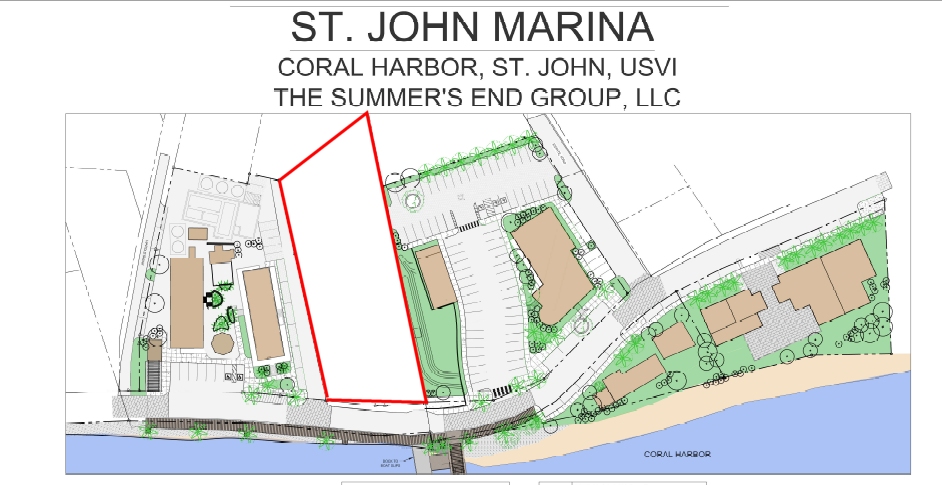
Rather than attempt to summarize the documents, they are all uploaded and available for review. This page has links to the entire August 2017 document submission by Summers End to USACE. As you can see, there is now a “hole” in the middle of the marina site plan – the location of 13-A and 13-B Carolina.
September 2017: Two Category 5+ Hurricanes Devastate Coral Bay
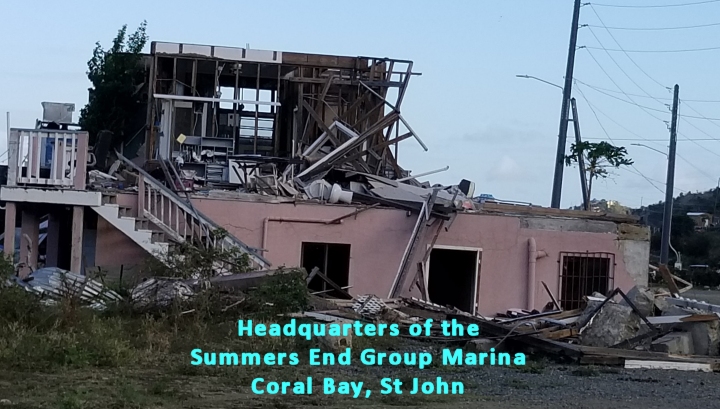
If you weren’t there, words cannot possibly describe the experience of Hurricane Irma in Coral Bay on September 6, 2017, a day that will live on in infamy. With winds speeds beyond the capability of measuring devices – certainly in excess of 200 mph – and tornadoes coming from all directions, our sole saving grace was that it was a fast moving storm. After three hours of nightmare there wasn’t much left to destroy, and what was left standing probably would have been gone had the storm lasted much longer.
And pouring salt into a gaping wound, just two weeks later Hurricane Maria dumped torrential rain and Category 5 winds on an already reeling Coral Bay. We were numb from Irma. We were zombies after Maria. But we came together as a community and helped one another and cared for the wounded and sheltered the homeless and we did survive.
It should have been obvious to any intelligent being that Coral Bay was NOT a place suitable for a mega yacht marina. Far from the nearest essential services, with direct ocean exposure, fragile infrastructure, Coral Bay is not where you want to build your 30 acre marina. The ONLY access to Coral Bay after Irma was by water – all roads were blocked by landslides, power lines, and debris. If that harbor had been littered with the debris from 1,333 pilings and 2 acres of dock structures, the people of Coral Bay would have been cut off from the outside world for days.
But apparently Chaliese Summers and Rick Barksdale, and their gang of well paid advisors, didn’t see it that way. They persevered, with renewed energy, presenting their case for an Army Corps permit while the people of Coral Bay were hard at work performing triage on our own lives.
I don’t think that anything about the Summers End Group was more poignant to me than knowing that while Coral Bay was struggling through a protracted period of isolation, literal powerlessness, Summers End was taking advantage of our diminished power by eagerly pushing forward with their Army Corps permit. They THOUGHT we could not respond. But we did.
October 26, 2017: Army Corps Issues Second Request for Additional Information
Although we were unaware of Summer End’s August submission to the Army Corps, and were unable to obtain copies of their documents until mid-December, the Puerto Rico office of the Corps of Engineers was still at work. On October 26, 2017 the Corps sent a “Second Comments for Rebuttal” letter to Chaliese Summers, identifying deficiencies in the August 2017 documents.
In prior submissions we had been able to provide input to the Corps prior to their formal review. But being literally cut off from communication, this review was done solely by the Antilles Office in Puerto Rico. We were very thankful that their review was thorough and completed while we were still busy recovering our lives.
2017 1026 SAJ-2004-12518 (IP) - St. John Marina, St. John - Second Comments for Rebuttal Letter - 26Oct2017December 2017: Summers End Responds With Additional Studies