In order to fully understand the processing of CZM permits in the Virgin Islands it helps to have some background understanding of the federal Coastal Zone Management Act (“CZMA”) enacted by the US government in 1972. The philosophy of the CZMA recognized that management of coastal resources is best handled at a very local level, however that management needs to be consistent with goals and policies established at the federal level. In particular, the emphasis of federal CZMA was to balance “utilization” (meaning development) with protection of coastal zone resources.
The federal CZMA program created a partnership between the federal government, under the National Oceanic and Atmospheric Administration (NOAA) and the coastal states and territories. The essence of this partnership is that if a state adopts a Coastal Zone Management Program which NOAA certifies as being consistent with federal CZM goals, then NOAA provides substantial funding for the state program, and commits that any federal action within the state or territory must be assessed by the state agency for consistency, prior to permitting. This relationship then cascades down, where states can authorize local CZM programs under the same consistency relationship.
In the USVI, the Virgin Islands Coastal Zone Management program was approved by NOAA in 1978 after a comprehensive Environmental Impact review, and the federally-approved VI CZM program is how we have regulated development of our coastal zone since that time. In the federally-approved USVI CZM Program, the agency designated for making coastal zone management consistency determinations is known as the Coastal Commission, a division with DPNR, acting through three island-based CZM Committees.
The 3-Phase Process: Application Review / Public Comment / Decision
The CZM review process proceeds through three phases: first, a permit application is reviewed by DPNR and CZM staff to make certain it is “complete” – meaning that all required documents are present, the application has been properly filled out, and the complete package is ready for public review. In the second phase the application package is distributed to government agencies and to the public for comment. Following the review period, the island CZM committee (which, by law, is supposed to consist of five island residents nominated by the Governor and confirmed by the Legislature), convenes a public hearing on the proposed development. In the final step, the CZM Committee reviews all public and agency comments, the applicant’s responses, and convenes a decision meeting to vote on approval or disapproval.
The basic requirement for approval and issuance of a CZM permit in the Virgin Islands is that the appropriate island Committee (for a major permit) or the DPNR Commissioner (for a minor permit) must find that the development is “consistent with the goals, policies, and standards” of the VI CZM Act, and mitigates to the greatest extent practicable, all impacts to environmental resources. This permitting regimen applies throughout what is known as “CZM Tier One” – basically lands with direct impacts to the surrounding waters, including all shorelines.
The CZM process is relatively straightforward and can be completed within 180 days, provided that the applicant submits all required documents and in a timely fashion. However, in their haste to have their project approved, the Summers End Group took some major “shortcuts” which would later doom the project to failure.
As should be self-evident, nobody can build a house on land they do not own, unless they have the land owner’s explicit permission. The same goes for commercial development – if a would-be developer such as the Summers End Group wants to secure a permit for a major development involving land they do not own, they are required by the law and regulations to have the “irrevocable approval” from all land owners to “complete the development proposed in the application.” Not only is this fundamental requirement written into the CZM regulations, but it appears explicitly on an affidavit attached to the permit application.
And to assure that the applicant is not speaking without land owners’ approval, the application requires the signatures of all property owners whose land is included in the project. The affirmation of authority and the signatures of the landowners are to be executed on a form known as “L&WD 5 Proof of Legal Interest.”
The detailed requirements for submitting, reviewing, and approving CZM permits are contained in Title 12 Chapter 21 of the Virgin Islands Code (the Virgin Islands Coastal Zone Management Act, or VICZMA), and the CZM Rules and Regulations (12 VIRR 900-914).
In particular, 12 VIRR 910-3 of the CZM Rules and Regulations identifies the required “Content of Coastal Zone Applications.” This section identifies the following requirements pertaining to the applicant’s authority to conduct the development described in the permit application:
- “Upon filing an application, the applicant shall be required to evidence in writing his legal interest in and right to perform development upon all property upon which work would be performed if the application were approved, including submission of all relevant legal documents.”
- “Where the applicant is not the owner of the property, the owners must co-sign the application before it will be accepted for filing.”
- The applicant shall have the burden of demonstrating to the satisfaction of the Commissioner the current validity of the legal interest upon which he bases all or any part of his application, before such application can be deemed complete.
- Every application shall be dated and signed by the applicant, attesting to the truth, completeness and accuracy of the contents under penalty of perjury.
These explicit requirements presented a challenge to the Summers End Group in 2014. SEG did not own any property at the marina site. They were proposing to use 7 adjoining parcels for the marina structures, including 4 parcels owned by native St Johnian families, 2 parcels owned by a bank, and 1 parcel owned by a long-standing St John resident family. And since SEG did not own any of these parcels, the regulations required them to demonstrate, in writing, their right to perform development on those 7 parcels, and each of the owners were required to co-sign the permit application.
SEG’s Lack of Legal Interest in the Marina Properties
The bank-owned properties presented the biggest challenge. Merchants Commercial Bank (the owner) only provided SEG with a limited power of attorney to apply for permits, expiring automatically in December 2014, and revocable at any time, and did not extend any authority for construction.
The other powers of attorney had similar restrictions, and none of them provided “irrevocable authority” to conduct development.
In spite of the explicit requirements, in March 2014 the Summers End Group filed a permit application lacking the “evidence in writing of legal interest and right to perform development” and submitted documents which did not meet the requirements of the regulations. Additionally, the space on the permit application required to be co-signed by property owners was left blank. Not a single property owner signed the permit application.
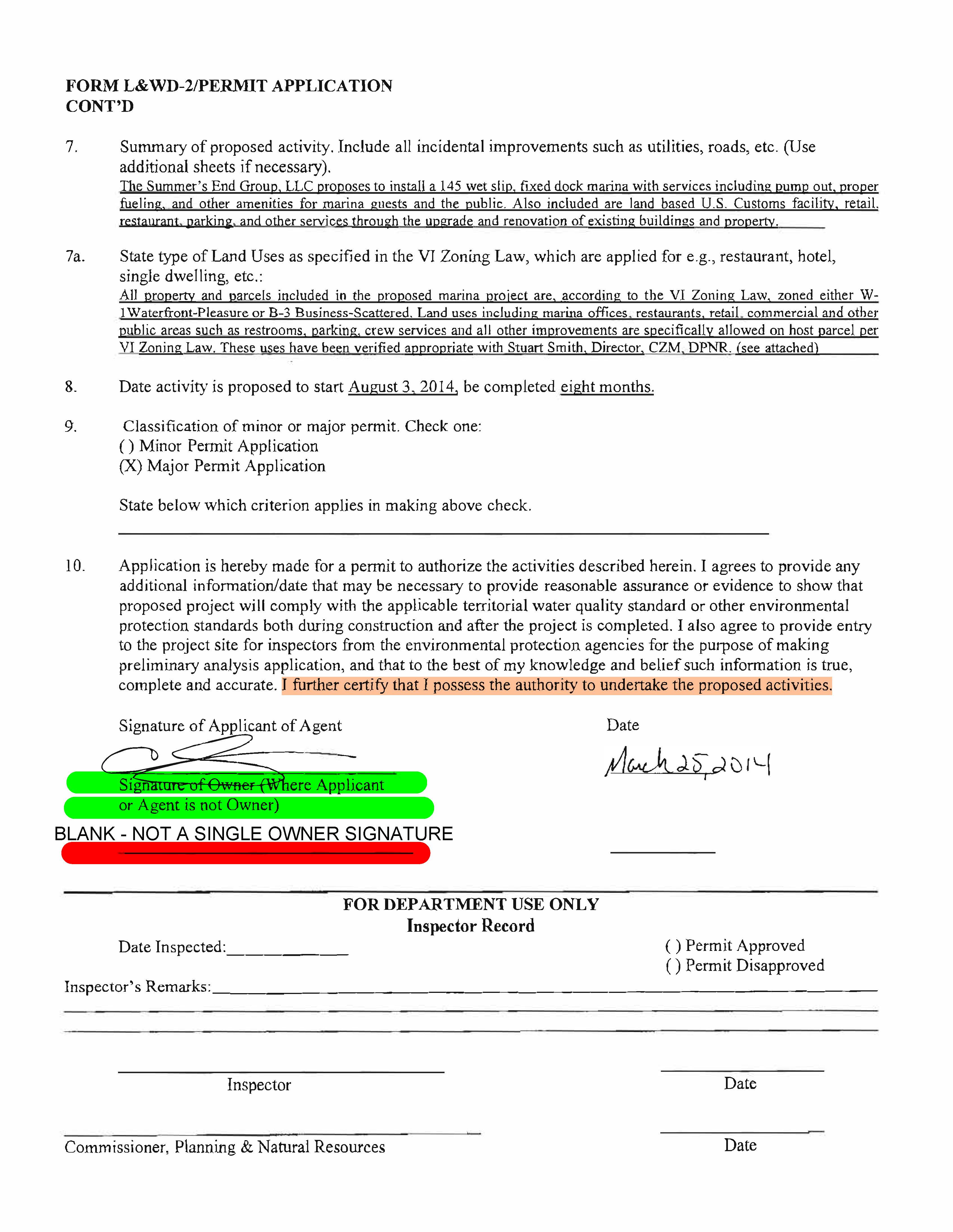
And the sworn “Proof of Legal Interest – L&WD 5”
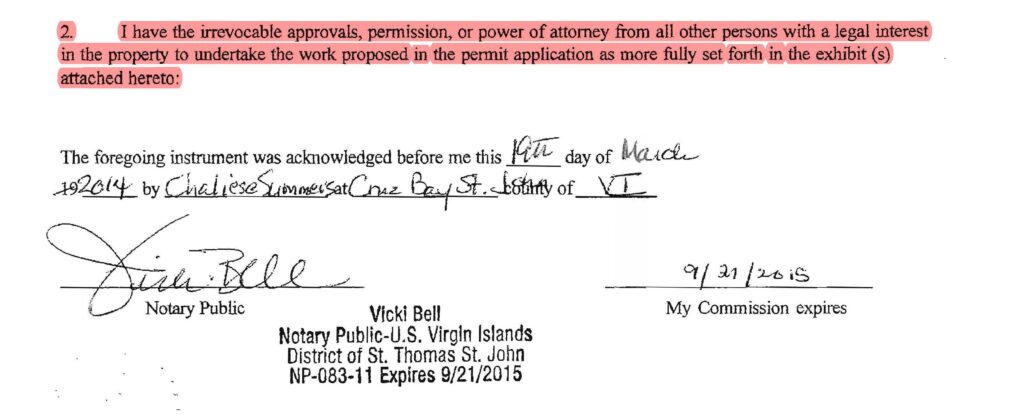
These defects should have been reason for DPNR to reject the application as “incomplete” under the regulations. When I noticed that the proof of legal interest was inadequate, I documented this fact and emailed the DPNR attorney at the time, who replied that he would forward to DPNR Commissioner Alicia Barnes and CZM Director JP Oriol. That was the end of that – I never heard another word from anyone in DPNR/CZM about the lack of legal interest and land owner signatures, in spite of follow-up on several occasions.